
Every few weeks, another AI tool comparison lands in my inbox. Copilot versus ChatGPT versus Gemini versus Claude, laid out in a tidy grid of green ticks. They are useful for about a week. Then a new model ships, a price moves, a feature jumps from "coming soon" to "shipped", and the grid is quietly wrong.
I build these grids too. Clients ask for them, and a good one earns its place in a decision. But I have come to think they answer the wrong question. "Which tool has the best features?" has a shelf life measured in days. The slower, more interesting question is this: which of these companies will still be here: training frontier models, honouring their contracts, employing their researchers: in five years?
That question has almost nothing to do with features. It has everything to do with who owns whom.
The comparison everyone makes is the wrong one
There is a familiar version of the AI conversation. Either one tool is clearly winning and you should standardise on it, or it is all hype and you should wait. Both are comfortable, and both miss what is actually happening underneath.
What is actually happening is that the companies we treat as rivals are quietly invested in each other. The "competition" between them is real on the surface: different products, different prices, different sales teams knocking on your door... But one layer down, the money flows in circles. And once you see the circles, you stop asking "who is best" and start asking the better question: who is structurally hard to kill.
Let me walk you through the board, because it is genuinely strange.
In AI, your rivals are also your shareholders
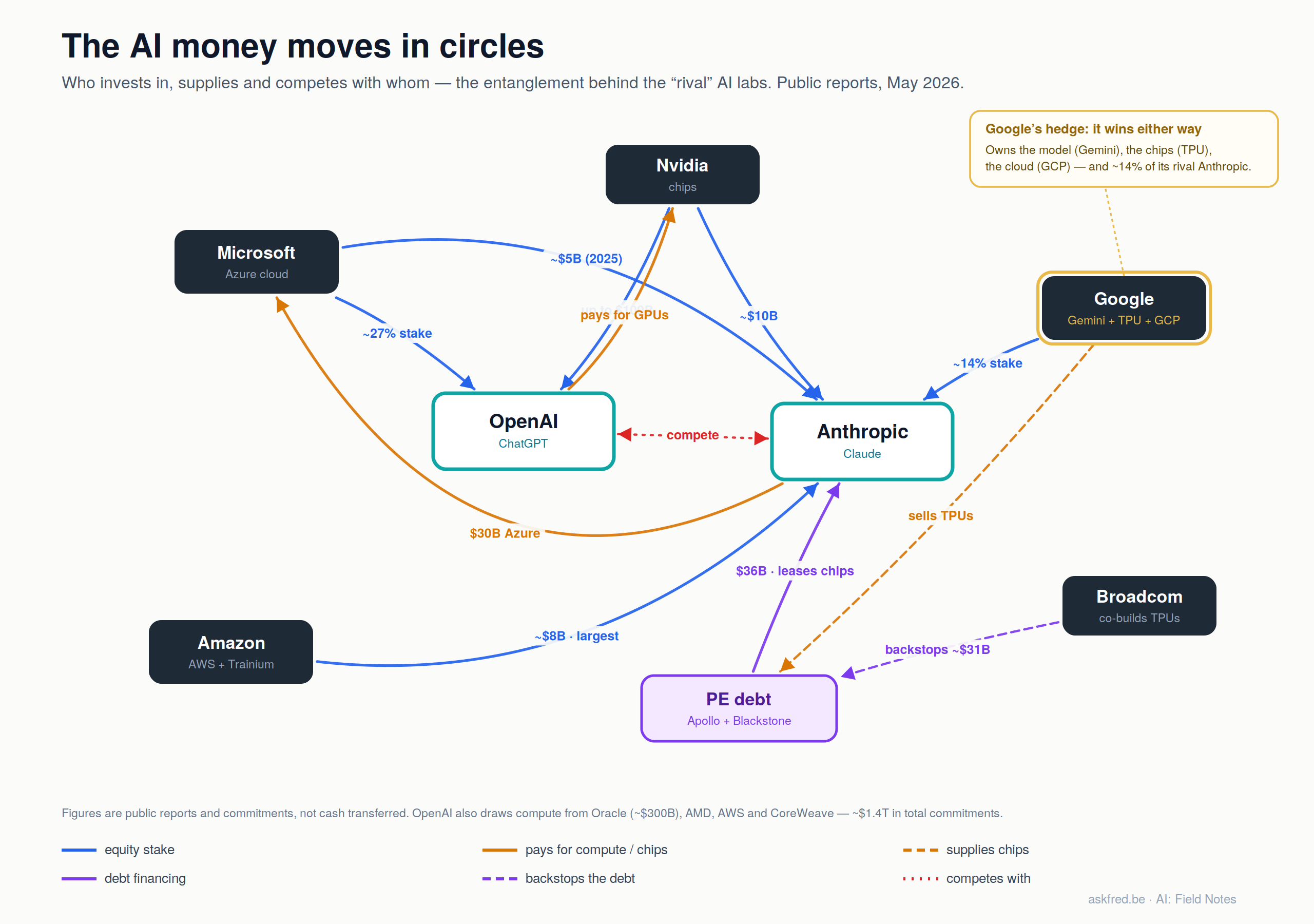
Start with Microsoft. It owns roughly a quarter of OpenAI (the maker of ChatGPT), the model inside much of Copilot. You would expect Microsoft, then, to be all-in on OpenAI. Instead, in late 2025, Microsoft and Nvidia committed up to fifteen billion dollars to Anthropic (= OpenAI's sharpest competitor) with Anthropic turning around and committing tens of billions back to Microsoft's Azure cloud. Microsoft now ships both companies' models inside its own products. It is not betting on a winner. It is the house, and it has chips on two numbers.
Now look at Anthropic, the company behind Claude. Its largest backer is Amazon, several billions deep, with Claude trained on Amazon's own chips. Its second major backer is Google, which holds an estimated fourteen percent of the company. Add the Microsoft and Nvidia money from 2025, and you have a single AI lab simultaneously funded by Amazon, Google, Microsoft and Nvidia. Four giants who compete ferociously with each other, all holding a piece of the same company.
Then there is the deal that made me want to write this. In May 2026, two private-equity houses, Apollo and Blackstone, started arranging roughly thirty-six billion dollars of debt, not to lend to Anthropic directly, but to buy Google's chips and lease them to Anthropic. The striking part sits in the fine print: Broadcom, the company that helps Google build those chips, is backstopping the bulk of that debt. In plain language, a chip supplier is underwriting the loan that buys its own chips. If the demand falters, the supplier eats the loss.
Read that twice. The supplier is guaranteeing the demand for its own product.
The circle
Step back far enough and the whole industry looks like this. Nvidia invests in OpenAI; OpenAI spends the money on Nvidia chips. Microsoft invests in Anthropic; Anthropic spends the money on Microsoft's cloud. Broadcom guarantees the debt that buys Google chips for a company Google co-owns. The investor is also the supplier is also the customer. The same dollars travel in a loop and get counted, in one form or another, at several stops along the way.
There are two honest ways to read this, and a good adviser holds both.
The optimistic reading is that this is simply how you finance something extraordinarily expensive and scarce. Frontier AI needs colossal amounts of compute, and the best chips are hard to get. So the players lock in supply by pairing long-term purchase commitments with financing. Call it a virtuous circle: it lines up suppliers, builders and customers to meet real, exploding demand. By this reading, the entanglement is a feature. It binds the strongest companies together so tightly that none of them can afford to let the others fail.
The cautious reading is that circular money can also flatter itself. When a handful of firms invest in each other and buy from each other, valuations and revenues can reinforce one another on the way up; and, in a downturn, on the way down. A profit that comes from revaluing a stake in a private company is not the same as a profit that comes from selling something to a customer who is not also your investee. Both kinds showed up on the same balance sheets this year.
I am not going to tell you which reading is correct, because nobody honestly knows yet. But for the decision in front of you, you do not need to resolve the debate. You only need to notice that the entanglement exists, and that it changes which companies are genuinely safe to depend on.
The most interesting seat at the table
Which brings me to the company I find most quietly fascinating in all of this: Google.
Look at where it sits. It makes its own frontier model, Gemini. It makes its own AI chips, the TPUs, rather than renting them from anyone. It runs its own cloud. And it owns an estimated fourteen percent of Anthropic, the very lab now taking on tens of billions in debt to buy Google's chips.
So consider the outcomes. If Gemini wins, Google wins. If Anthropic wins, Google still books the gain on its stake and sells Anthropic the silicon to get there. There was a quarter this year where roughly half of Alphabet's record profit did not come from search, ads or cloud at all. It came from revaluing its stake in Anthropic. The company is positioned to profit from its own competitor's success.
That is not an accident. It is the most hedged position on the board: own the model, own the chips, own the cloud, and own a slice of your strongest rival. You do not have to like Google to recognise that this is structurally difficult to lose from. Whoever wins the model race, Google has a seat in the winning car.
This is the part the feature grid can never show you. On a grid, Google is one column among several, scored on whether it has this feature or that one. On the ownership map, it is sitting in the middle of the table.
What this means if you actually have to choose
Here is the practical translation, because a field note that ends in cleverness has failed.
When you adopt an AI tool, you are not buying a feature. You are making a multi-year bet on a company: its survival, its independence, its ability to keep its promises. The demo you saw last week is the least durable thing about that decision. So when you weigh your options, weigh the things that actually age well:
Who stands behind it. A model from a company backed by several giants, running across several clouds, is a safer multi-year dependency than one resting on a single patron. Diversified backing is not glamorous. It is insurance.
Who controls it. Some of these companies are founder- or mission-controlled, with investors deliberately kept out of the driver's seat. Others are tied tightly to a single corporate parent. Neither is wrong, but they carry different risks, and you should know which you are buying into.
Who makes the chips. Independence from any one supplier (or, in Google's case, making your own) is a quieter advantage than benchmark scores, and a more durable one.
And, frankly, who is too entangled to be allowed to fail. It is an uncomfortable thing to factor in, but the web of cross-investment means some of these companies are now load-bearing for each other. That is a form of resilience, even if it is not a reassuring one.
None of this means ignore features. Features decide whether a tool is useful today. But durability decides whether the bet you are making today still makes sense in three years; and that is the timescale most real decisions actually live on.
A few honest caveats
I would not be doing my job if I dressed this up as more certain than it is.
The eye-watering figures (fifteen billion here, a hundred billion there) are mostly commitments, not cash in the bank. "Up to forty billion" is a headline, not a wire transfer. Treat them as direction and intent, not as settled fact.
And this is a snapshot. This corner of the world moves faster than almost anything I have written about. Every number here is true as I write it in May 2026, and some of it will have shifted by the time you read it. The dollar amounts will date. The shape of the thing (...investor is supplier is customer; a few players too tangled to fail; one company hedged across the whole board...): will not.
So, the short version. Stop asking which AI has the best features this month. Start asking which of these companies you would still trust to exist, and to keep its word, in five years. The grid goes stale. The map does not.
Don't buy the best model. Buy the company that will still be training one when it matters.
We could keep pulling this thread
You'll have noticed names I left off the map. That's deliberate, but it's worth saying where it goes next, because each omission points one level deeper or one step further out.
Add Meta, and the thesis gets its counter-example: a frontier-scale lab funded by ad profits, giving its models away, sitting almost entirely outside the circular web. Not everyone is playing the same game.
Go one level down from the chips, and you reach TSMC: the Taiwanese foundry that actually manufactures the silicon that Nvidia, Google and Broadcom only design. Every chip arrow on the map quietly runs through one island. Pull that thread and you are no longer writing about AI; you are writing about geopolitics.
I am not going to map all of that here, and that is the whole point. You can always go one level deeper and one degree wider; and you should, before you make a bet you will live with for years. The feature comparison asks what is best this month. This way of looking asks what holds up, and what is underneath it. That second question does not come with a tidy table. It comes with a direction: look down a layer, and look further out. Most decisions get made one layer too shallow and one year too short.
If you are working through how AI fits into your own organisation, not the demo, the decision, we are always happy to compare notes.
One last note, and rather the point: the research behind this piece (tracing a dozen tangled deals across filings and reporting) was done with an AI assistant in an afternoon. The reading of what it all means is mine. That division of labour, as I have written before, is the whole argument.
Sources & further reading
Every figure and deal above comes from public reporting or company filings, not from me. The main ones, grouped by claim, so you can check any of them yourself:
- The $36B chip-financing deal (May 2026): Bloomberg and Reuters (via Yahoo Finance) on Apollo and Blackstone arranging roughly $36 billion of debt to buy Google TPUs for Anthropic, with Broadcom backstopping about $31 billion of it.
- Microsoft and Nvidia investing in Anthropic (Nov 2025): Bloomberg, CNBC and Axios on the up-to-$15 billion commitment and Anthropic's ~$30 billion Azure pledge, and on Claude running across all three major clouds.
- Microsoft's ~27% of OpenAI: Om Malik's reading of Microsoft's Q1 2026 10-Q filing, drawn from the filing itself.
- Google's and Amazon's stakes in Anthropic: Fortune on the estimated ~14% Google stake, and on how revaluing it produced roughly half of Alphabet's record quarterly profit.
- OpenAI's compute commitments (~$1.4T): CNBC on the Oracle (~$300B), Nvidia (up to $100B), AMD, Broadcom and AWS deals.
- The "circular financing" critique: Bloomberg's explainer on how the same firms invest in, supply and buy from one another.
All accessed May 2026. The large dollar figures are announced commitments and reported estimates, not audited cash flows: see the caveats above.